




ONME News Reports: Effectively connecting state resources to Californians was demonstrated during the pandemic and the 2020 census, say state officials
Updated: May 15
“Trusted messengers” were the key to the successful strategy to reach vulnerable and hard-to-count communities–it still works today, say state officials
By ONME Newswire - Julia Ann Dudley Najieb
Watch ONME News Reports Part 1 & 2: The California Connects Regional Convenings, an 8-city statewide tour launched in late 2025 by the Office of Community Partnerships & Strategic Communications (OCPSC) to connect local leaders, nonprofits, and community partners directly with state agencies, aimed to strengthen regional networks and provide tools for community resilience.
News producer and host, Julia Ann Dudley Najieb, talks with California administrative leaders, Sacramento political leaders, and the OCPSC administrative team about the bridging of California's resources to Californians, using trusted messengers.
Even with the fluctuating exodus of people leaving the state, California remains the most populous U.S. state with approximately 39.35 to 39.5 million residents, considered the wealthiest U.S. state in terms of total economic output, possessing the largest state GDP—often ranked as the world’s 4th largest economy. However, according to the California Budget & Policy Center, key challenges for California residents include the highest cost of living in the continental U.S., severe housing shortages, and high poverty rates. Residents face immense pressure from high taxes, high gas prices, traffic congestion, and a crisis in homelessness, while also managing environmental threats such as wildfires, drought, and rising energy bills. Ironically, the state provides valuable resources that people may not realize they have access to or are eligible to utilize.
Before the COVID-19 pandemic and economic slowdown, California had the highest poverty rate in the nation, according to the April 2021”Mending the Net” report. The report continued that an estimated 4.4 million people in the state at that time were unable to meet their basic needs each day; California’s public benefits systems was not reaching every eligible person, with some programs missing over a million eligible people.
“Since the COVID-19 pandemic began, millions of Californians have lost their jobs, dropping them into economic insecurity and on a path toward poverty,” said the report. “In these circumstances, public benefits are a lifeline that can help families maintain a semblance of economic security while weathering the storm. These benefits help families pay their utility bills, put food on their tables, access public transportation, receive healthcare, access childcare and do a myriad of other necessary activities to survive. Yet many people never get the benefits they have a right to. Time and again, across the spectrum of the safety net, California fails to connect people to lifesaving programs.
Also, the California Budget & Policy Center public repot had given the state a dire warning at the beginning of 2020, as they too noticed the disconnect of state resources being unavailable to individuals and communities who were unaware:
“State policymakers have many opportunities to continue building the state’s fiscal health and invest in the people of California as they consider policy priorities for 2020-21 and beyond. While California is a wealthy state home to many high-income households and businesses that have been able to greatly leverage resources and expand their wealth in the last several decades, millions more Californians live a different reality every day. Workers in low- and mid-wage jobs are unable to afford the high cost of living – from paying for housing and childcare to stretching their paychecks at the end of the month to cover food and medical bills. This is true no matter what region Californians work in across the state and call home. For women, Californians of color, and immigrants the economic challenges and disparities are vast. The state is in danger of allowing millions of Californians to spend their lifetimes in financial distress.”
Currently, over 31,500 nonprofits operate across California and support a range of government services and programs, such as job training, meals at food banks, and rental assistance. Their work is financed in part through awards from state agencies, according to the Milton Marks “Little Hoover” Commission on California State Government Organization and Economy, which is an independent state oversight agency created in 1962. In 2025 the commission put out a survey to nonprofits across the state as an attempt to measure the implementation of recent legislation. The survey proved the suffrage of such nonprofit groups and organizations that were integral to getting the state’s resources out effectively and efficiently to the public.
While California nonprofits face an empirical union of surging demand, declining funding, and intense staffing shortages, the state of California, realizing the disconnect of its legislature with Community-Based Organizations (CBOs) several years ago, saw the need to step in by being a better guide for CBOs which would then bridge the gap with vulnerable populations and available services and resources the state provides through these trusted messengers. This has been a four-year, continued intervention to connect California to community; nonprofits and groups, media and community outlets were mostly clueless of the valuable resources available for their communities.
So, the state sought to reach the masses by first supporting its CBOs through regional convening across the state. They were a network of “trusted messengers,” adopting the outreach strategies from the COVID-19 pandemic and the California 2020 census campaigns.

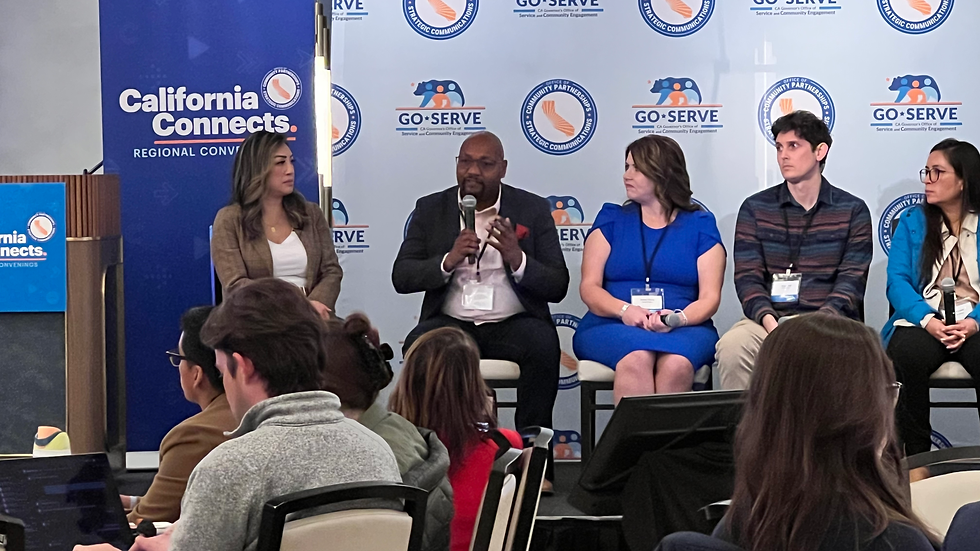
Josh Fryday, GO-Serve Director and California Chief Service Officer who serves in a leadership position with the California Governor’s Council for Career Education and a member of Governor Gavin Newsom’s Cabinet, leads the Office of Community Partnerships and Strategic Communications (OCPSC.) At the April 23, 2026, regional convening in Sacramento, Fryday confirmed the COVID-19/2020 Census strategy, also reiterating they have reached the biggest benchmark yet—building a community within.
“The fact that we have today, 300 people from almost 200 organizations around the state of California coming together, I think shows the impact—shows that it’s real what we have created, that we are reaching communities in different ways, news ways and better ways, and that we are going to continue to do that and improve,” said Fryday, “and that we have built a community—that’s the benchmark: that we have created a real community of the people who are helping their communities.”
“We learned a lot from COVID that in order to actually be successful and making California successful that the organizations who are actually able to reach people on the ground and reach deep in the communities need to be supported. We need to make sure they have the resources to be successful and that’s the work we have been doing over the last four years …it is working, and we’re going to continue it.”
OCPSC Acting executive director, Aubrie Fong, said mastering the ecosystem to reach Californians is the key, especially utilizing the ethnic and community media in connection with schools, CBOs, and other trusted messengers.
“The state can create so many different resources and programs—and we do, and they are amazing,” explained acting executive director, Fong. “But we really need to make sure Californians can access them. Whether that is culturally responsive materials, or we just heard also from amazing ethnic and community media folks—The ecosystem of trusted messengers is so important; we know it takes a certain amount of touches (seven or so touches) for a person to really be moved from hearing the information … it is also through ways that they trust receiving information. A lot of that is our cultural newspapers, ethnic media, radio in languages that our community members speak so that they are hearing the surround sound of the same information from the organizations, the schools and from the people they trust in the community, also with their ethnic and community media outlets.”
The use of ethnic and community media has been a game changer for the state of California, who realizes that these small media businesses carry big voices for the state.
OCPSC press secretary, Ashley Williams, urges CBOs to reach out to ethnic and community media outlets to communicate what they are doing to help their neighboring communities. She stressed the importance of such a connection for the greater good of all involved.
“I think it’s important, and the state feels like it's important because our ethnic media partners are really on the ground in communities telling stories that are important to our communities,” said OCPSC press secretary Williams. “They are oftentimes some of the folks who are most deeply invested in these stories. It is so important for our community-based organization partners, our state agency partners, to really understand the role that these media organizations play and truly getting to the meat of the story that our organizations, our partners have to share. I think some folks may have a little bit of fear when it comes to speaking with media. But it’s really not something to be scared of; it’s really how you get your story out, how you amplify it, how you increase the visibility, how you bring resources to your communities to your areas.”
In part three of this news story series, CBOs and trusted messengers remark on the changes they look forward to making in their organizations, the assistance from the state, and how available resources will help their communities in California.

Comments